
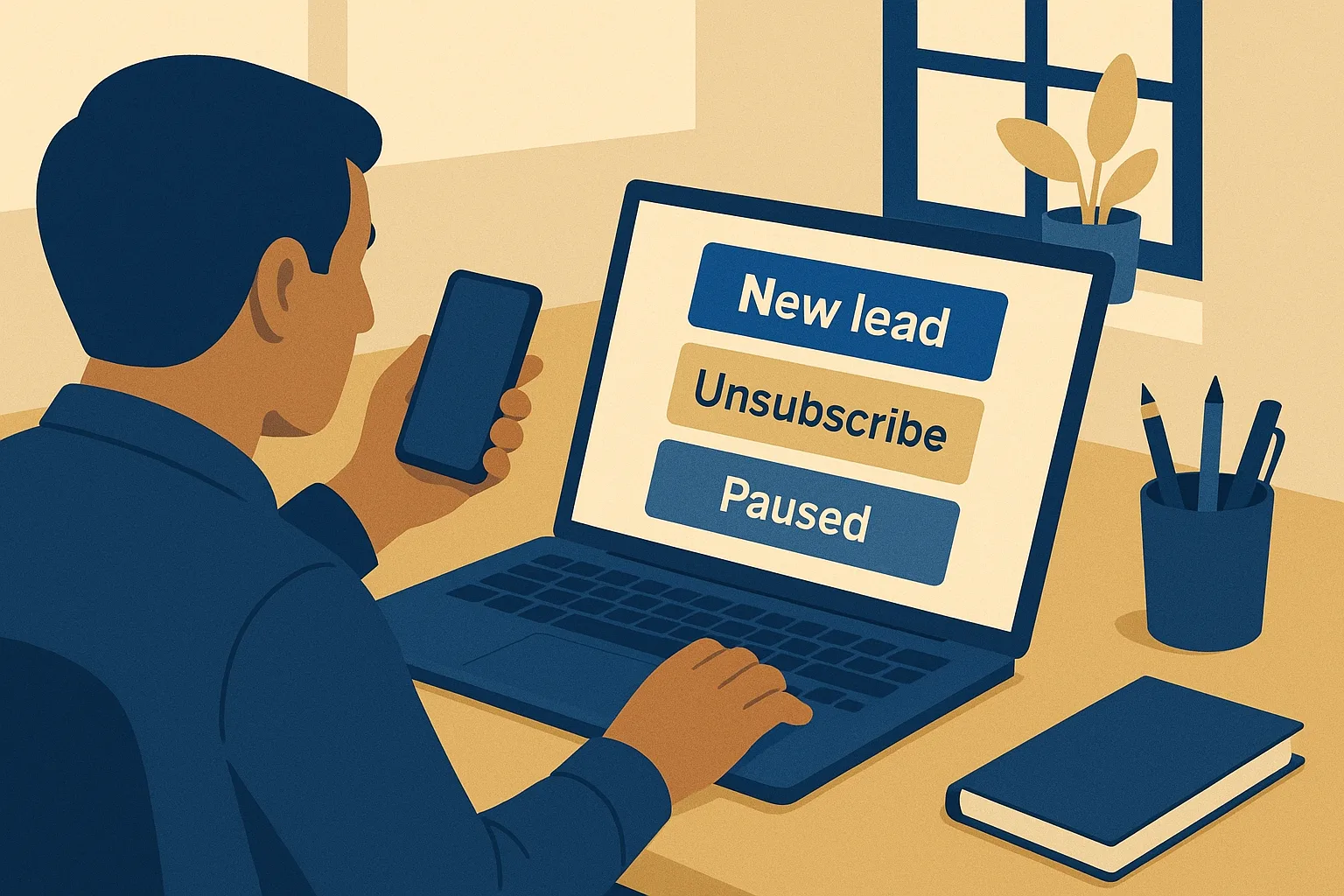
Here’s the short answer to when cold email is the wrong choice for a small business: when your sale depends on trust, fast follow-up, and precise targeting you can’t yet deliver. That combination amplifies risk and drains limited time you need for higher-yield channels.
If reply speed is a gap, shore it up with Lead follow-up automation. Centralize contacts with CRM automation, and let an AI receptionist triage after-hours replies; see Why lead response speed decides who wins the job for why this matters.
If your best-fit buyers search and compare, consider publishing instead—Content and social media automation can help you stay consistent.
It is also when cold email is the wrong choice for a small business if you lack compliance basics, list quality, or the capacity to handle responses the same day.
What cold email is—and why fit matters
Cold email is unsolicited outreach to people you haven’t interacted with before. It differs from newsletters or transactional emails because there’s no prior relationship. It also differs from “warm” outreach to event connections, subscribers, or referrals who expect to hear from you.
Used carefully, it can open conversations you’d otherwise miss. But it requires preparation, tight targeting, and strong controls to avoid brand damage. If your offer is complex, high-trust, or local-reputation-driven, the risks often outweigh the benefits until core systems are in place.
When cold email is the wrong choice for a small business
- Your work is advisory, reputation-driven, and usually begins via referrals or introductions.
- Buying cycles are long, committee-based, or shaped by legal review that favors known providers.
- You don’t have a clean, role-verified list; purchased volume substitutes for qualification.
- Your team can’t respond within business hours to promising replies, or can’t pause sends quickly.
- In Greater St. Louis professional services, where relationships carry weight, mismatch and mistiming compound quickly.
- You sell to consumers or into regulated categories where consent rules and expectations are stricter.
- Your website, booking flow, or proposal templates aren’t ready to convert interest into a next step.
- Your differentiation requires a consult, assessment, or demo to be credible—hard to convey in a cold thread.
- You plan to send from your primary domain with no reputation isolation or monitoring.
If several of these describe your situation, that’s a clear signal to prioritize other channels first.
Reputation and compliance risks
Brand damage happens fast when emails seem deceptive, lack a working unsubscribe, or hide who is contacting whom.
Spam complaints and blacklisting can follow and hurt deliverability across your domain. Even a small batch can create inbox placement issues that affect invoices, project updates, and legitimate marketing.
Domain health and operational strain
The U.S. Small Business Administration notes that poorly managed marketing can create real risks to operations and reputation (SBA). If you lack time to triage responses, you may miss positive replies and frustrate prospects.
Compliance also requires honoring opt-outs and maintaining accurate sender identity; skipping these basics invites complaints. None of this is legal advice—only a reminder that the cost of shortcuts typically exceeds the benefit.
These are moments when cold email is a poor fit because the collateral damage lands on core business communication.
Better alternatives for advisory sales
- Referrals and warm introductions create lower-friction conversations and higher close rates. Make asking easy with a short, paste-ready blurb.
- Content and search can attract prospects already comparing solutions. Publish concise, helpful guides that answer real buyer questions. If bandwidth is thin, use Content and social media automation to keep a consistent cadence.
- Local networking and education—events, associations, workshops—let prospects assess fit without inbox noise.
Quick wins this month
Two practical moves this month:
- Ask five clients for one introduction each.
- Publish a short explainer that answers the most common pre-sales question you receive.
Measure success by qualified conversations, not likes or impressions. These channels build familiarity and credibility that compound over time.
If you still plan to test, meet these prerequisites
Identity and compliance
- Verify your sending domain and align SPF, DKIM, and DMARC.
- Use a clear sender identity and include a working, honored opt-out on every message.
Targeting and list hygiene
- Build contacts from verifiable sources with role relevance; remove generic or outdated addresses.
- Start small to validate fit and messaging before scaling.
Control, pacing, and service levels
Monitoring and control
- Route replies to a monitored shared inbox; pause sends on positive or negative responses.
- Use an approval checklist for copy, targeting, and volume on each run.
- Pre-write response templates for common replies (interested, not a fit, referral) to speed thoughtful follow-up.
Service levels
- Define a same-day reply standard and ensure staffing can meet it consistently.
- Set clear stop rules for low-reply or high-complaint signals and review outcomes weekly.
Edge-case pilots: reaching back out to recent event conversations or closed–lost opportunities from the last few months is not truly “cold.” Treat those as warm re-engagements with higher context and lower risk.
These safeguards often reveal gaps before the market does—making it clear when to pause and invest elsewhere.
Decide and next steps
Decide whether your next best client is more likely found through trust or interruption. If trust wins, you have your answer. If interruption might work, only move forward when you can maintain identity, targeting, and response standards without sacrificing current clients.
A quick rule of thumb:
- If your last wins came from introductions or in-depth consults, double down on those paths.
- If your offer is transactional and clearly solves a narrow, time-sensitive problem for a specific role, a tightly scoped micro-test may be acceptable.
- If you cannot guarantee same-day replies, pause outreach and fix that first.
If you do test, start with 25 highly qualified contacts, clear stop rules, and real-time monitoring. Assess success by conversations booked and fit, not vanity metrics.
Want help building the right foundations before any outbound? Book a quick consult.