
Real systems
Call flow, start to finish
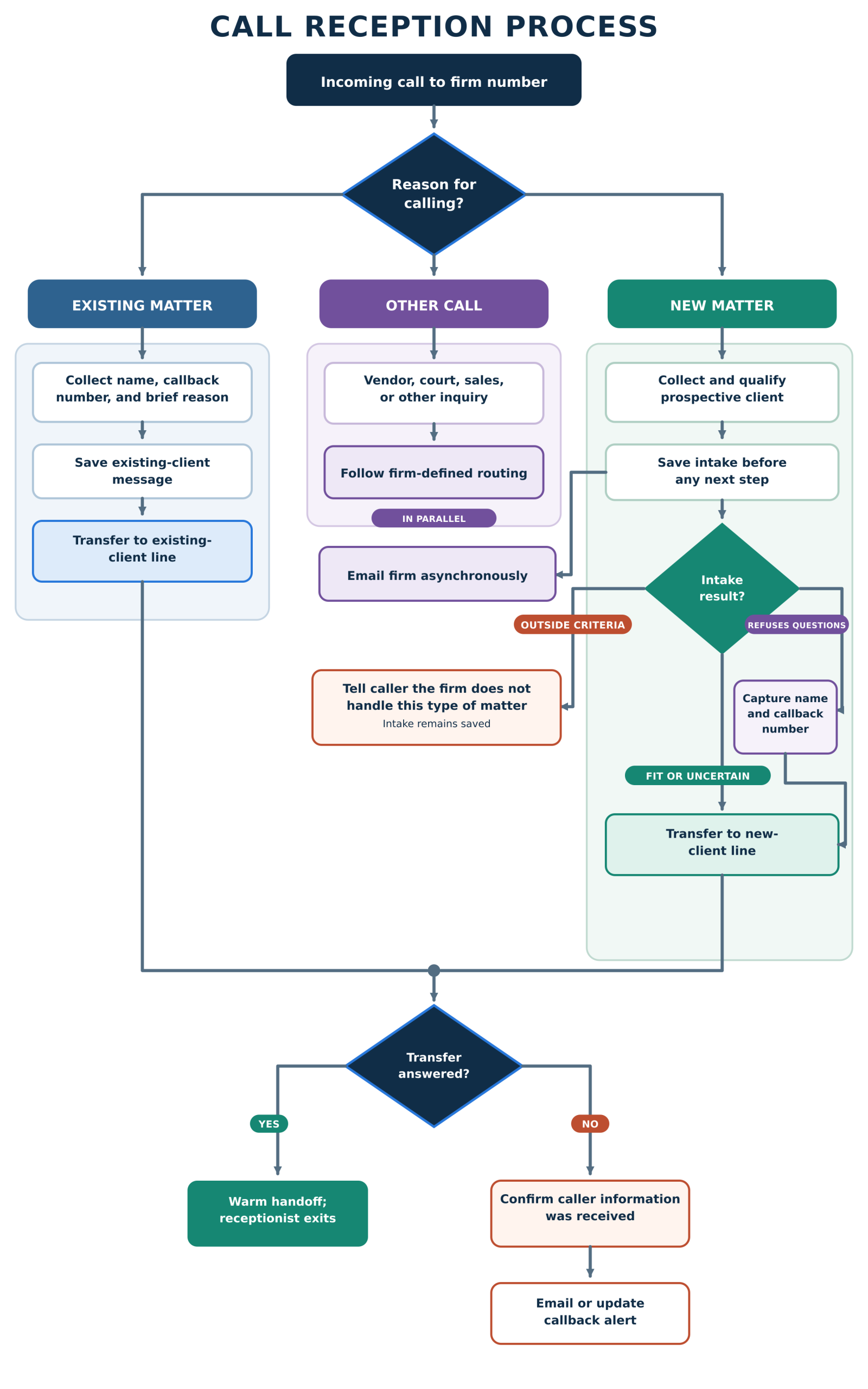
The diagram below is this system configured for a law-firm intake line. It separates existing-client calls from new inquiries, saves the intake before any transfer is attempted, and falls back to a callback alert when nobody picks up.
Internal deployment
AI receptionist, CRM lead capture, and post-call follow-up
This system answers inbound calls, works from approved business information, collects structured lead details, classifies the call outcome, and sends the result into separate post-call workflows.
- A caller reaches the AI voice assistant.
- The assistant answers approved questions and identifies the reason for the call.
- It collects useful contact and project details without pretending to know information outside its instructions.
- The lead-capture workflow normalizes the submitted fields.
- The CRM is searched before a record is created.
- An existing person is updated or a new person is created.
- A separate webhook sends a structured post-call email to the business.
- Calls that require judgment, support, or a callback are routed to a person.
- Approved knowledge only
- Defined call outcomes
- Create-versus-update logic
- Normalized contact fields
- Human callback and escalation paths
- Structured post-call summaries
- Separate workflow responsibilities so one failure is easier to diagnose
Internal build in active development
Business discovery, normalization, deduplication, and Twenty CRM sync
Workflow
- Scheduled collectors retrieve business records from approved sources, including NPPES dental and plastic-surgery data.
- Each source run is recorded so failures and source performance can be traced.
- Original source data is preserved before normalization.
- Business names, phone numbers, domains, addresses, categories, and source identifiers are normalized.
- Deterministic matching and fallback identity fields prevent duplicate canonical businesses.
- Source provenance is linked to the canonical business record.
- A self-hosted SearXNG discovery workflow searches for a likely official domain and scores candidate results.
- Qualified companies are created or safely updated in Twenty CRM.
- Suppression, verification, and outreach eligibility are designed as required gates before any campaign can send.
Controls
- Original payload retention
- Source-run logging and error handling
- Idempotent upsert behavior
- Domain and phone normalization
- Duplicate prevention
- Business-source provenance
- Safe create and update paths
- Separation between discovery and outreach eligibility
Handoff
Operational enablement and system ownership transfer.
- Technical documentation
- Team training
- Operational runbook
Support
Ongoing performance governance and system optimization.
- System monitoring
- Iteration cycles
- Performance adjustments
Internal deployment
WordPress article production and social repurposing
Schedule and draft
A schedule starts the article workflow.
The system prepares a topic, article draft, metadata, target terms, and supporting image.
Image alt text and caption data are retained with the asset.
Taxonomy and assemble
WordPress categories and tags are resolved or created.
Content, taxonomy, image, and metadata are assembled into the final post.
Internal links are inserted where they are relevant.
Publish
The finished article is published to WordPress according to the approved publishing state.
Repurpose and track
A separate workflow watches the blog RSS feed.
It fetches and normalizes the full post, generates platform-specific social copy, and records the result in a Google Sheets publishing ledger.







- Structured output parsing
- Separate article and social workflows
- WordPress taxonomy handling
- Alt text and image metadata
- Publishing ledger
- Ability to require review before publication
Next step
Your workflow will not be identical—and that is the point
Useful automation is built around the trigger, data, rules, systems, exceptions, and risk of the actual process. These examples show the way AutomateSTL approaches that work: preserve the source, make decisions visible, log important actions, and keep a clear route back to a person.
Lead Intake & Enrichment
- Cleaner leads. Faster handoff.
Support Triage
- Faster triage. Cleaner queues.
Invoice Processing
- Fewer errors. Faster close.